skip to main |
skip to sidebar

Create jobs themselves, is the best way to build a future in the midst of the difficulty people are looking for an office job. Especially for those less fortunate in the formal sector, but has the creativity and unyielding spirit. Supriyanto (25), resident Wirobrajan WB II/226 RT 06 - RW 02 Yogyakarta is the figure of a young boy who tried to self, his family with butterfly handicraft business. Fur once largely wasted, in the hands of creative young people turned out to be transformed into a colorful "butterfly" pretty, though only imitation.
This idea emerged in 2003 ago. Along with Dana, his partner, he tried to innovate how to use fur in addition to the shuttle cock or duster. "Once we've ever made flowers. Good and behavior in the market, but the essence is difficult because they have to choose a thin coat ", he said.
The butterfly is made from fur menthog with white background. To be able to get good quality hair, he must hunt outside the city, to places of slaughter poultry. One sheet costs have reached $ 60. Although you have to choose, but in the next process is still there to be sorted.
After going through the process of coloring into blue, green, yellow, brown, orange and others, then made the wings according to the pattern. Each butterfly takes 4 pieces of fur. Sengon body was made of wood. Proboscis of flower buds that have been processed so it is very durable. "Putiknya I bought from friends, including for the eyes", he said on Tuesday (19 / 7) at his home, just north Wirobrajan SD Muhammadiyah 3 Yogyakarta.
The young man admitted that the experiment was not completely finished. At first he tried with chicken feathers, but the coloring process is rather difficult. Finally finding a more suitable menthog fur.
***FOR handicraft products to market this, first he must sell himself on the front sidewalk Great House, Jalan Malioboro. While in Yogya Yogyakarta Arts Festival took place (FKY), highlighted the complex art fairs Vredeburg, the butterfly was on display at his own booth. It turns out this unique craft attract attention and orders kept coming.
Given a stainless wire rod, like a butterfly flying, swinging to the touch. Packed without stalks, often used to beautify the bridal chamber, mounted on the curtain with the help of safety pins in lieu of flowers. Also many booked for a wedding gift, both in plastic packaging and a small box.
Supri artificial butterfly is also there that took him to Jakarta, Bali, Sulawesi, Kalimantan, to be sold there. Who every Sunday, he held a butterfly merchandise and various handicrafts at GMU campus Bulaksumur which is always crowded for jogging and other sports.
The manufacturing process is very complicated. Everything is handled manually, so that the maximum daily production of just 50 pieces. If you order a lot, it adds time so that the number could reach two-fold. For resale, he pegged the price of Rp 1500 per fruit. Looking at the complexity of how to create and price the material must be purchased, the price is far from expensive.
Maintenance of artificial butterflies is not difficult. To remove dust, simply by duster fine. Cleaned once a week is enough. The color is still bright. Moreover, if each day.
From this handicraft business, Supriyanto got two pride. He was able to create their own jobs and be able to provide economic value of goods that previously wasted. Besides, he also feels better income than when he became a private employee who previously lived

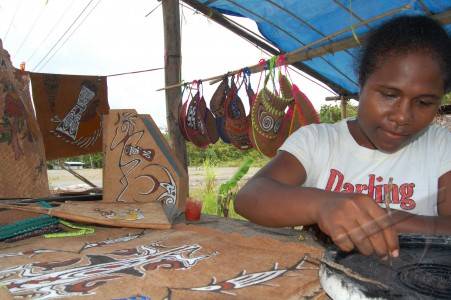
But public interest in the Valley Bada Lore also has a distinctive craft of leather crafts from wood. Usually the men in this valley will be around to find a tree with a beautiful leather among other duties of trees, breadfruit or banyan whose numbers are many in this valley. But the Tree of Customs of the most frequently used and only in this Bada Valley.
Ethnic customs house Lore Tambi has named a special building that is usually created as rice granary often called Buho ', but in reality we now also often used for leather processing wood. The search results are good bark on the river be cleaned only after it submitted to the Tribe women Lore and then processed here.
Bark that has been cleaned will be boiled until tender and then processed with the tools to be a wood fiber peboba then beaten with ike and aligned with the bamboo. After all process is done, the bark is dried in their respective home pages.
After drying the women will start work of high artistic flavor that is drawing the pattern on the bark. Usually they use a pencil first and then be given the bright colors are taken from the essence of the existing trees in this valley.
Wood crafts are usually developed into a scarf or dress clothes for women, custom hats for men, tablecloths or wall hangings. Everything is made with typical patterns of Ethnic Lore.
In addition to these wood crafts are also found in the form of woven rattan handicrafts are also widely found in the Bada Valley. Wicker rattan also has a unique color like the colors found in the bark handicrafts Ethnic Lore of the dominance of pink, green and yellow.
To get this craft we can come to the Valley of Bada and directly witness the making. We can also buy them as souvenirs. The price varies from Rp 50,000 to Rp 100,000 depending on the magnitude. The price is also relatively expensive due to the slow construction of about 2 weeks for one item and only few people can.
Many different kinds of sea shells scattered on the beach turned out to be processed into a variety of beautiful suvernir. Economic value too high, even as far as the overseas marketing. In the fishing village in Desa Tasik Apex Court, Central Java, this is the handicrafts made from sea shells easily found.Is Suryadi, one artisan ornaments made from sea shells that have been seventeen years to pursue this craft. Created beautiful holiday decorations, a photo frame, sculpture and various other decoration.Suvernir making process is quite easy. To make it, it takes only an abundance of shells on the beach, plywood, and wood glue. Making crafts was started by smearing glue gets to be attached mussels. Furthermore, mussels attached to the pattern that has been planned. The fruit is hand made from shells sold for three thousand dollars, to seventy thousand dollars."For marketing itself is Solo, Yogyakarta, Semarang, Kudus, Pati also exported to overseas. The price was very bervareasi from one thousand to seventy-five thousand", Said Suryadi craftsmen suvernir this sea shells. Besides sold in several shanties in Rembang, Central Java, in the hands Suryadi suvernir also been exported to the United States
 You know the shell or coconut shell? For most people may not be useful coconut shell. Coconut shell when in fact it is very useful to be made crafts.
Who would have thought with a modified shell waste capitalize with pandanus and banana bark rope, this one makes the product worth of art and the more desirable. Therefore, not surprisingly, various handicrafts made from coconut shell is often found in every shopping mall in the downtown area attractions such as Yogyakarta, Bali and Lombok.
Various Forms
Coconut shell crafts being sold to be used as hand pieces with different shapes. Starting from women's accessories such as pins, picture frames, to home furnishings like spoons and bowls.
Besides coconut shells can also be formed into drinking glasses, trays, lampshades, spoon, fork, or spoon vegetable. With the touch of a very fine art, handicrafts coconut shell looks very artistic. Even the results of this coconut shell crafts can be a variety of bags with various shapes (models) and sizes, various forms of model rail curtains, lamp cup, cap, manik-manik/kancing, and others.
The materials needed to make kerajianan from coconut shells is fairly easy to obtain, such as wood glue, tangkel (coconut shell), putty, melamine, sandpaper and paint. Also texwood also needed to be made crafts such as product order desk and small closet attached tangkel.Agar visible exterior artistic, fiber from coconut shell should be highlighted. Because diseratlah inherent artistic value stronger than this effort, in addition to unique forms are made.
the coconut can be used. The inside can be eaten. Other parts can be made into handicrafts. Even the origin of coir handicraft products that can be exported, of course after going through processing.One of the area known as the producer of coir handicraft products are Kebumen. With a clever label which stands for various handicrafts from coconut fiber, Darda, 40, could expand its business which are not only known in the country alone. The brand, he said, already getting a patent through a process facilitated by the government.In the country, handicraft production process was considered by the government. Earlier this year, it got an award from the Ministry of Industry as a business Ecogreen Industry Award for small-scale industrial groups. The new award was first performed by the Ministry of Industry.Other awards came from abroad. The quality of quality has been recognized in Europe. The product was also awarded Cemari, one leaning against the quality of Europe. "We process coconut fiber without using chemical balian. All the friendly environment that can be used for various purposes and nothing is wasted," he said.With the plunge as a crafter coco Kebumen he wants to be the center of handicraft products from coconut. "I want to Kebumen known as a craft center that processed oil from the root to the leaves of coconut," Darda said, one fiber crafters from the area. If people need a product made from coconut, he said, the center found in Kebumen, Central Java. Various kinds of products made. There are at least 50 items of products such as mats, ropes, pots, rubberi mir-zed, net, organic fertilizer, and others.Marketing its products to areas in Sumatra, Kalimantan, Java, Bali, until Irian. He sold it in a large number of parties and do not have a retail store, because in those areas as well as many other crafters coco. It also receives orders for both domestic and foreign.In addition to the domestic market, he also serves requests from overseas. About 20% of its production for export to Malaysia, Hong Kong, and several other countries. The product of coconut fiber, he said, in foreign countries are used to manufacture a working way for the asphalt road is not moving when traversed by heavy vehicles. Other uses of coir products good to resist erosion, and for seaweed cultivation media, and the rope tambang.i - u.ii! 38, Darda's wife, said its exports have not done directly. They are through intermediaries primarily to penetrate into Malaysia, South Korea, U.S., and China.Meanwhile, the price range mat reached Rp3.500-Rpl50.000 per square meter. In 1 month, said Siswati, using raw materials as much as about 34 tons. He admitted no shortage of raw materials, Uarena in the area many coconut trees. If the dry season, he bought into neighboring regions in Banjarnegara and Ciamis.Since 1977 efforts have not direct like that. However, he has been through it since 1997. Initially, Darda recalled, her parents were working as craftsmen coconut fiber, but is still done manually, marinated. The fourth child of 10 siblings were interested to continue the business his parents, but do more advanced than their parents.But after graduation STM, he did not go jump to continue his father's business and also did not continue their education into college, but work for the experience. He fled to Malaysia to work for six years. "I work to raise capital, while learning," recalled Darda. fter collected money for working capital and have the experience, he returned to his native region to continue the business his parents.From the experience that has gotten in the neighboring country, he began to develop the coconut coir. Sabutnya processing already done by using the machine, although that is still simple to use machine, an important result. He started the business in 1997. From there, the employees began to grow. Now it reaches about 169 people. Most of them work on the coconut fiber weaving at home with wholesale system. Darda has opened up jobs for the environment.Meanwhile, the working of the coconut coir be at their homes, so Darda dapal open up the jobs for residents in the vicinity. He did a wholesale system. Fiber materials that have been processed and the ground was done by residents of surrounding areas for a variety of craft products. He claims processing of coir products are environmentally friendly. Nothing is a waste, all used for various purposes. "I want to make Kebumen as a center of handicrafts from coconut," Darda said turnover is now expected to reach USD! 50 million per month
When creativity meets with the art it will create a product that has high artistic value. Diana Herawanti example, the founder and owner of this Spinifex can make handicraft products which should diacungi jempol.Dalam make crafts, a girl born in 1974 the use of recycled paper, eggshells, pineapple fiber, and so forth.
Spinifex was established in 2002. Diana originally fad recycle used paper is mixed with pineapple fiber is processed into frames and bookmarks. The girl was born in Kediri also use the shell / skin of the egg which is then painted and filled with wax. Having finished his sell to souvenir shops in Yogyakarta, it sells handicraft goods. And from now on that's Spinifex producing handicrafts from recycled paper and various souvenirs candles. Goods produced as follows: frames, jewelry boxes, pencil cases, bookmarks, candle glass, floating candles, candle baskets, candle cactus, ice cream and candles. You could say Spinifex products including environmentally friendly. The price varies depending on the case and the model. The cheapest USD 550, was Rp 1,500, Rp 20,000 expensive.
For the procurement of raw materials is not a lot of trouble because there are sellers near his place of business papers used and stores that sell candles. Spinifex can spend each month approximately 50 kg and 20 kg of wax paper. Until now, home industries that make various kinds of souvenirs such has 3 permanent staff, 2 section production and that one person as marketing. In terms of marketing, Spinifex sell handicraft items in the souvenir shops and supermarkets in Yogyakarta. There are also buyers who come dar India came to the house and bought Spinifex products for resale to their home country.